Liquidnet at
Eurex Derivatives Forum Frankfurt 2026
25 - 26 February
Congress Center Messe Frankfurt

25 - 26 February
Congress Center Messe Frankfurt
Building on decades of expertise and development, our Listed Derivatives service combines Liquidnet’s technological edge with a long history of operational excellence to create a trusted, evolutionary environment consistent with our Members’ needs.
With an unconflicted agency model, we’re evolving Futures + Options execution.
Meet the team

Daniel Noorian
Head of Execution and Quantitative Services

Oliver Deutschmann
Managing Director, Head of Equity Derivatives, EMEA

Miriam Koestel
Head of Equity Distribution DACH

Andrew Arnold
Director, Senior Execution Trader - US Equity Options
Live from Eurex
Swing by again soon… our on-the-ground experts are gearing up to drop the good stuff!
Prep for your next session
Stay tuned here during the event while we provide impactful insights to help you make the most of select panels during the day.
Daniel Noorian | Head of Execution and Quantitative Services
What's going on
Europe’s position in global markets is changing, and fast. As the region sits at the centre of today’s most significant geopolitical and economic shifts, investors are watching closely and assessing what all this means for them. Rising geopolitical tensions, evolving tariff regimes, increasing market fragmentation, and persistent macroeconomic volatility are no longer temporary disturbances; they are becoming structural forces reshaping Europe’s financial landscape.
One trend already stands out. As regional economies diverge, listed derivatives are gaining importance. Their transparency, standardisation, flexibility, and liquidity make them essential tools for navigating the current environment. In a world where risks are increasingly interconnected, derivatives offer a disciplined, efficient way to hedge exposures and implement views with confidence.
Europe’s potential to attract a larger share of global flows, and reduce its reliance on U.S. markets, is a prominent theme in today’s landscape. Yet questions around economic growth, competitiveness, and the region’s pace of innovation remain front and centre. This blend of momentum and uncertainty brings both challenges and opportunities, particularly as investors seek benchmark instruments to manage macroeconomic and region‑specific risks.
Ultimately, understanding how Europe responds to global pressures is crucial for market participants allocating capital and managing risk. As global risks become more complex and interconnected, listed derivatives are emerging as indispensable tools for effective risk management and capital deployment. Supported by informed execution and strong market expertise, they provide a resilient, transparent framework for navigating uncertainty with confidence.
Why it matters
Europe is reshaping its place in a rapidly evolving global financial system. Geopolitical tensions, shifting trade dynamics, and growing market fragmentation are influencing how capital moves across the region and heightening Europe’s relevance for global investors. With economies advancing at different speeds and debates around competitiveness and innovation still unfolding, understanding Europe’s direction is essential for assessing exposure, identifying risks, and spotting emerging opportunities. In a landscape where global forces are increasingly interconnected, clarity on Europe’s trajectory helps investors navigate uncertainty with confidence.
Questions to ask
Which sectors or asset classes in Europe are most exposed to prolonged geopolitical fragmentation?
What steps can Europe take to attract and retain international investor capital in an increasingly competitive global landscape?
Oliver Deutschmann | Head of Equity Derivatives, EMEA
What's going on
The global macro backdrop remains challenging as we head into 2026. Tariffs, geopolitical tension, and active conflicts continue to influence the outlook, while shifting regional dynamics and rapid technological disruption add another layer of complexity for investors.
On top of this, markets remain near their highs, questions around debt sustainability persist, and interest rates still appear too low, all against a backdrop of continued dollar weakness. Taken together, this creates a landscape where vigilance, flexibility, and disciplined risk management are more crucial than ever.
Why it matters
Amid this challenging backdrop, potential market moves bring both risks and opportunities. New trends will emerge, some significant, others overstated. At the same time, artificial intelligence is poised to reshape the investment landscape in profound ways. The real question is not if it will transform markets, but how.
Questions to ask
Where are the key risks? Regionally and potentially different market wise?
How will AI reshape the investment process, where is it overrated?
How is the global order going to look like in 10 years from now? What's the new USD? Can Europe make it the EUR? The Yuan or even the Rubble?
Daniel Noorian | Head of Execution and Quantitative Services
What's going on
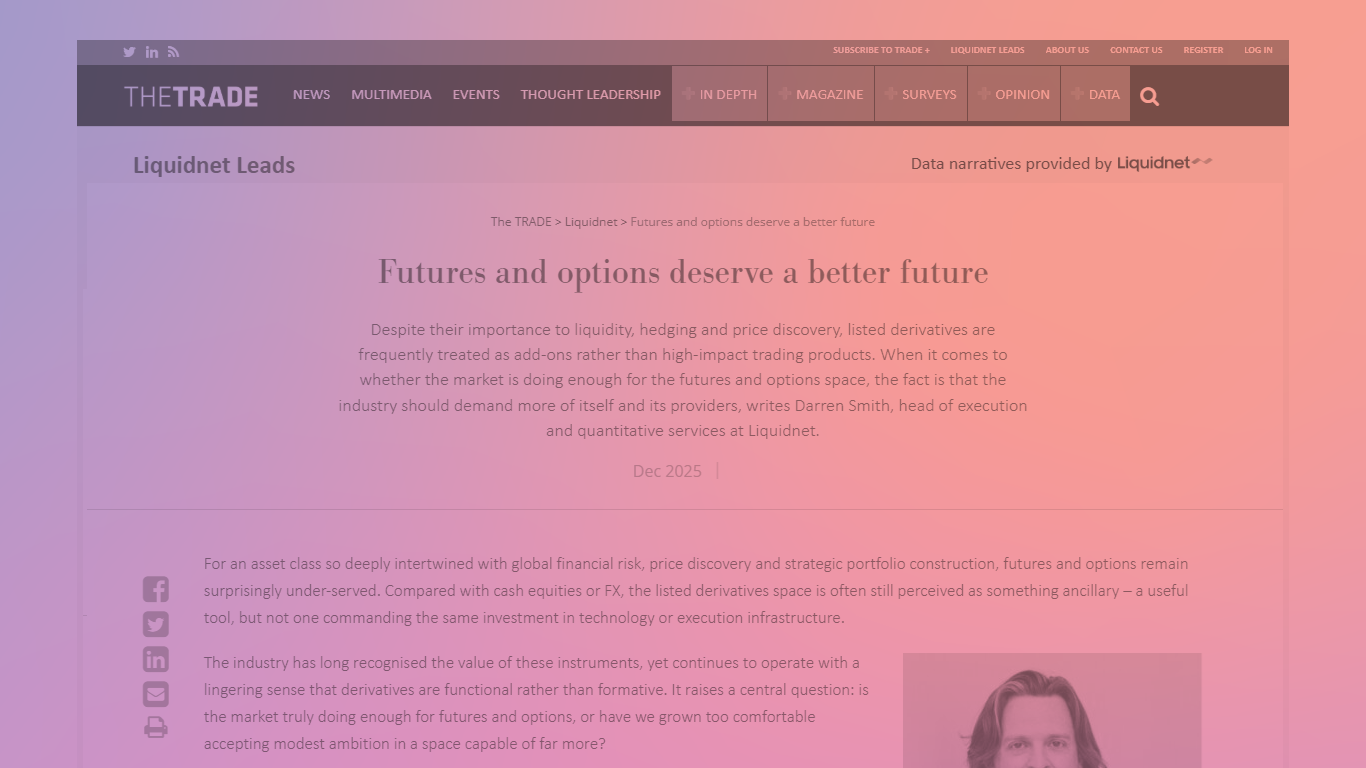
When we look specifically at listed derivatives, it’s clear that futures, despite being early adopters of electronic trading, haven’t kept pace with the technological progress that has transformed equities and fixed income. This is a key topic shaping the future of listed derivatives, and one we explored in our recent article for The TRADE, “Futures and options deserve a better future”, which you can read here, as technology and automation underpin much of the work we’ve done in developing Liquidnet’s listed derivatives business.
As a non‑bank provider, we take a distinctive approach in this space. We prioritise high‑quality execution using independent algorithms, and we pair this with strong investment in analytics through our proprietary in‑house pre‑trade platform.
Why it matters
As buy side desks evolve, traders are being asked to handle a broader range of instruments while adopting a more analytical approach. Time constraints and the need for swift execution mean smaller flows can be automated, typically routed through algo wheels, freeing traders to focus on larger trades. When it comes to analytics, they enable desks to better determine the most appropriate execution method, whether that’s liquidity‑seeking or schedule‑based algos, or opting to trade on risk via a block trade.
This shift has led to a more hybrid trading model on the buy side, raising the question of whether the sell side should adapt their coverage to match. New futures products, for example, often require different execution approaches depending on liquidity. Another important consideration is what happens downstream: as execution desks become more automated, operational issues tend to decrease thanks to improved STP processes.
Questions to ask
Which part of the futures or options market could benefit most from automation or technology?
Will this have a knock on impact for high touch trading/desks?
How will OMS/EMS vendors respond to changes and will they be able to support new protocols?
Andrew Arnold | Director, Senior Execution Trader - US Equity Options
What's going on
Volatility remains a defining feature of European markets, but its drivers have shifted meaningfully. The introduction and rapid adoption of daily expiring options on the EURO STOXX 50 and DAX has reshaped how investors manage short-dated exposures. Settling at the 17:30 CET close, these contracts have become a liquid tool for targeting specific event windows.
At the same time, cross‑asset volatility relationships are diverging. Equity, rates, FX, and credit volatility no longer move in tight correlation. Activity in daily options now regularly clusters around European‑hour macro releases such as CPI and NFP. This behaviour is offering a more granular read on how markets price near‑term risk.
Taken together, these shifts signal a more episodic, event‑driven volatility regime, one that requires traders and risk teams to reassess how they interpret signals and how they structure hedging and execution around much shorter cycles.
Why it matters
For buy‑side desks, these shifts have real implications.The expansion of daily expiring products enables far more precise hedging, but it also introduces new timing and liquidity considerations, particularly around the 17:30 CET settlement window where hedging flows increasingly cluster.
Additionally, as cross‑asset volatility breaks from historic patterns, firms must increasingly integrate multi‑asset signals, dispersion views, and relative‑value structures into their overlays to avoid being caught offside in fast‑moving markets.
Finally, as volatility regimes become more fragmented, the quality of execution, whether through high touch blocks, auctions or electronic channels, becomes even more central to performance, especially around key data releases where daily‑expiry flows peak.
Questions to ask
How has Europe’s volatility regime changed since 2020 across equities, rates, FX, and credit, what’s structurally different now versus prior cycles?
What product or market structure innovations would most improve buy side outcomes over the next 12–18 months?
Where are the most compelling opportunities in European volatility markets for 2026, whether in dispersion, cross asset relative value, or event driven convexity?
What's going on
Futurization has continued to gain momentum since the financial crisis and the OTC reforms introduced under Dodd‑Frank, enabling firms to benefit from lower costs, greater transparency, and operational efficiencies through standardisation and margin offsets.
We’re already seeing adoption in parts of the OTC landscape, for example, through ERIS swap futures and growing interest in FX futures driven by uncleared margin rules. While exchanges are strong advocates of the shift and the buy side is increasingly engaged, some sell‑side liquidity providers remain reluctant.
With opportunities to capture both alpha‑related benefits and meaningful operational gains through margin efficiency, futurization is likely to attract growing focus.
Why it matters
Futurization allows investors to replicate a broader range of OTC‑style products within a futures wrapper. This can enhance transparency and improve liquidity, as a wider set of non‑bank liquidity providers is able to enter the market.
Execution costs can also fall. Not only through lower upfront trading fees but through improved balance‑sheet efficiency for both the buy- and sell-side participants. Margin offsets and reduced capital charges, for sell‑side firms, play a major role here.
In some cases, futurization can lead to new liquidity pools forming as liquidity migrates from off-book (block trades) to functioning two way screen markets. That shift is a strong indicator of a healthy futures contract.
Questions to ask
There have been a number of new product launces such as credit futures and the recently launched systematic QIS index futures. What do you the next area of the market to be “futurized” will be?
Do you think it matters for futurization if these new products are typically traded off screen via block?
Execution on the green:
Swing, execute, win.
Check out the leaderboard to see who’s absolutely owning the putt streak challenge, one putt at a time. And if you haven’t had your turn yet, swing by the Liquidnet booth and get in on the fun!
| First name | Surname | Number of putts |
|---|---|---|
| Lawrence | Peirson | 10 |
| Christian | Rausch | 5 |
| Pascal | Souchon | 4 |